Showing posts with label Best USD to INR. Show all posts

Saturday, 24 May 2025

How to Avoid Currency Conversion Losses When Transferring Money to India

How to Avoid Currency Conversion Losses When Transferring Money to India: The Ultimate Guide

How to Avoid Currency Conversion Losses When Transferring Money to India: The Ultimate Guide

A comprehensive strategy to maximize your remittance value and minimize hidden costs

Updated: May 24, 2025 15 min read

1. Introduction: The Hidden Cost of International Money Transfers

Chart showing billions lost to hidden cross-border fees

When sending money to India, most people focus only on the advertised transfer fee—but this is just the tip of the iceberg. The real cost often lies hidden in unfavorable exchange rates and undisclosed markups that can significantly reduce the amount your recipients actually receive.

According to a recent study, Indians paid over ₹263 billion (approximately $3.5 billion) on foreign exchange fees in 2020 alone, with roughly ₹97 billion hidden as exchange rate markups on currency conversions. This means that for every ₹100 sent to India, a significant portion never reaches the intended recipient due to these hidden costs.

The Real Impact:

If you're regularly sending money to India—whether to support family, invest in property, or for business purposes—these hidden costs can add up to thousands of dollars annually.

This comprehensive guide will equip you with strategies to identify these hidden costs, compare money transfer services effectively, time your transfers strategically, understand tax implications, and leverage digital tools to maximize every rupee that reaches your Indian bank account.

2. Understanding Currency Conversion Losses

Before diving into strategies, it's crucial to understand exactly how and where you lose money during currency conversion. International money transfers incur losses through multiple channels:

2.1. Exchange Rate Margins
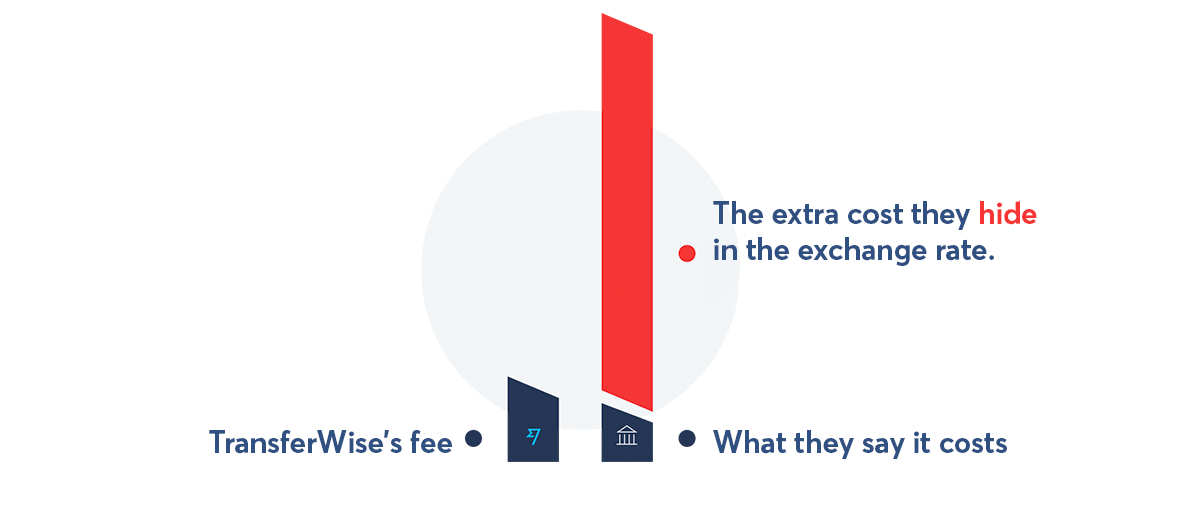
Exchange rate margin illustration showing the difference between mid-market rate and provider rate

Exchange rate margins represent the biggest source of hidden costs. When a provider offers an exchange rate, they typically use a rate that's less favorable than the mid-market rate (the real exchange rate you see on Google or financial news sites). The difference between these two rates is their profit margin.

Example:

If the actual mid-market rate is 1 USD = 85.5 INR, a transfer provider might offer you 1 USD = 83.5 INR. On a $1,000 transfer, this 2% margin means the recipient receives ₹2,000 less than they would at the true rate.

2.2. Fixed Transfer Fees

These are the most visible fees, typically ranging from $0-50 depending on the service. While some services advertise "zero fees," they often compensate by offering poorer exchange rates.

2.3. Receiving Bank Charges

Indian banks may charge a fee for receiving international transfers, typically ranging from ₹100-1,500 depending on the bank and transfer method. These fees are often overlooked in calculations.

2.4. Intermediary Bank Fees

For transfers using the SWIFT network, multiple intermediary banks may process the transaction, each potentially deducting their own fee from the transfer amount. These fees are unpredictable and can range from $10-30 per intermediary.

Pro Tip:

When comparing services, calculate the total amount that will be received in India after ALL fees and exchange rate differences—not just the advertised transfer fee.

3. Comparing Money Transfer Services
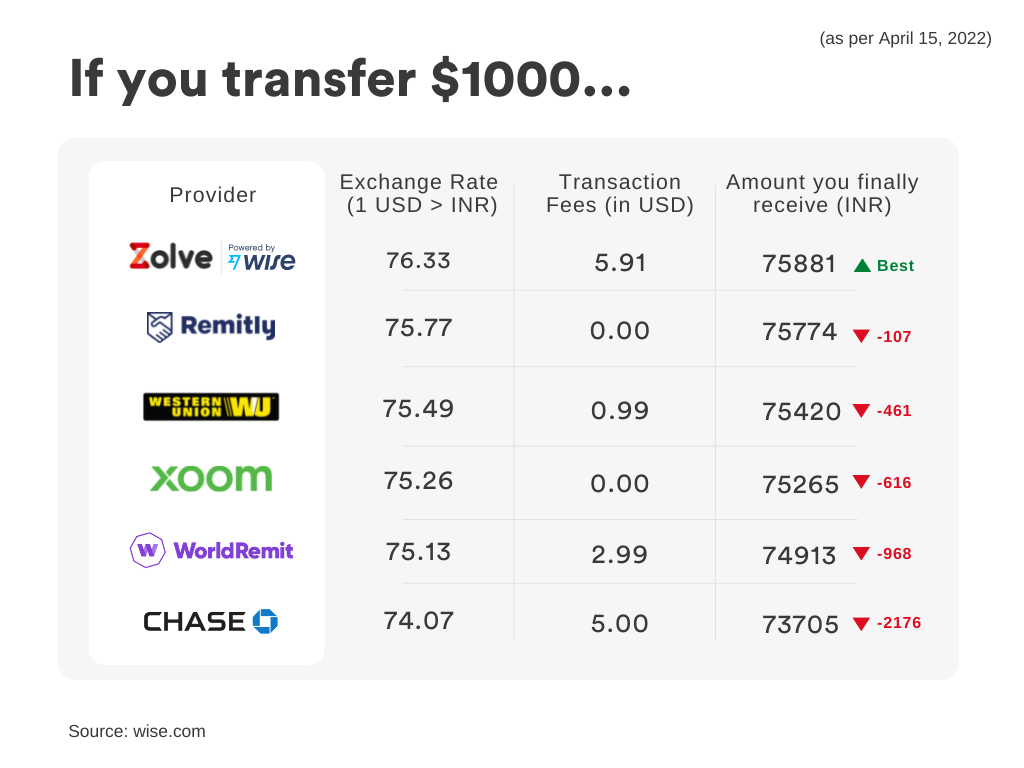
Comparison of money transfer services to India

Not all money transfer services are created equal. Here's a comparative analysis of the most popular options for sending money to India:

Service Typical Exchange Rate Margin Transfer Fees Speed Best For
Wise (formerly TransferWise) 0.4-0.5% $1-4 1-2 business days Transparency, competitive rates
Remitly 0.8-2% $0-3.99 Minutes (express) to 3-5 days (economy) Speed, first-time user promotions
Xoom (PayPal) 1-3% $0-4.99 Minutes to 1-2 business days Convenience for PayPal users
Western Union 2-4% $0-5 Minutes to 1-2 business days Cash pickup options
Bank Transfers 3-5% $20-50 3-7 business days Familiarity, established relationships
InstaRem 0.6-1% $0-4 1-2 business days Regular transfers, loyalty program

3.1. How to Compare Effectively

To truly compare services, follow this process for each transfer:

  1. Check the mid-market rate on Google or XE.com first
  2. Input the same send amount on multiple services
  3. Note the final INR amount the recipient will get (after all fees)
  4. Compare this final amount, not just the transfer fee
  5. Consider speed requirements and convenience factors

Pro Tip:

Use comparison tools like Monito, RemitFinder, or CompareRemit to get real-time comparisons across multiple providers in one place.

3.2. Service Selection Strategy

Different services excel in different scenarios:

For Regular Small Transfers (Under $1,000)

Services like Wise, Remitly, and InstaRem typically offer the best value due to their low fixed fees and competitive exchange rates.

For Larger Transfers (Over $5,000)

Consider specialist services like OFX or even negotiating rates directly with your bank for premium exchange rates. Some services also offer better rates for larger transfers.

For Emergency/Urgent Transfers

Remitly's Express service, Western Union, or Xoom offer near-instant transfers to India, though typically at a higher cost.

For Absolute Best Rates

Wise consistently offers rates closest to the mid-market rate. Skydo is another emerging option with competitive rates for India transfers specifically.

4. Strategic Timing of Your Transfers

Currency fluctuations and timing transfers to India

Timing your transfers strategically can save you significant money, especially for larger amounts. Currency values fluctuate constantly due to economic data releases, geopolitical events, and market sentiment.

4.1. Best Days and Times

  • Mid-week transfers (Tuesday to Thursday) often offer better rates than weekends.
  • Morning hours in the US (when Indian markets are closed) can sometimes offer better rates.
  • Avoid transfers during major Indian holidays when banking systems may be slower.
  • The first half of the month typically sees more stable exchange rates than month-end.

"Mondays often experience the lowest number of trading in foreign exchange market. Therefore, you may expect the least fluctuation in price." - WorldRemit Research

4.2. Monitoring Exchange Rate Trends

For larger transfers, it's worth monitoring exchange rate trends over a period of time:
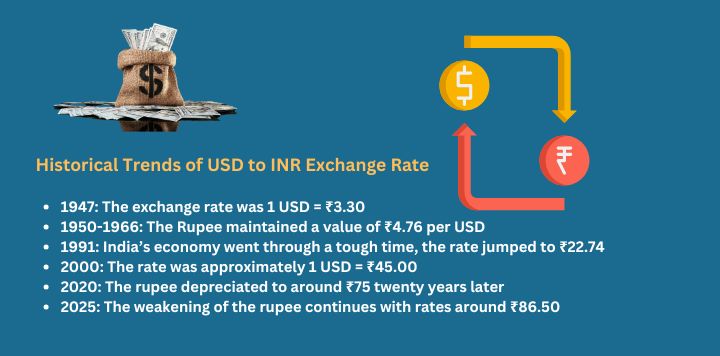
Historical trends of USD to INR exchange rates
  • Follow economic indicators like US Federal Reserve announcements, which often impact USD/INR rates.
  • Major Indian economic data releases (inflation figures, GDP growth) can cause short-term fluctuations.
  • Political stability or instability in either country can impact exchange rates significantly.
  • For transfers over $10,000, consider tracking rates for 2-4 weeks to identify favorable trends.

Pro Tip:

Set up exchange rate alerts on apps like XE, Wise, or dedicated currency tracking apps. These will notify you when your desired rate is reached, helping you time your transfer optimally.

5. Identifying and Avoiding Hidden Fees

Hidden fees in international wire transfers

Hidden fees are the biggest culprit in reducing the value of your transfers. Here's how to identify and avoid them:

5.1. Exchange Rate Markup Identification

The most significant hidden cost is usually in the exchange rate margin. To identify this:

  1. Check the mid-market rate on Google, XE.com, or financial sites
  2. Compare this to the rate offered by your transfer service
  3. Calculate the percentage difference (Provider Rate ÷ Mid-Market Rate × 100)
  4. Anything below 98% means you're losing more than 2% in exchange rate markup

Beware of "Zero Fee" Offers:

Services advertising "no fees" or "fee-free" transfers typically make their money by offering exchange rates 3-5% below the mid-market rate. Always check the exchange rate being offered against the mid-market rate.

5.2. Indian Bank Receiving Fees

Different Indian banks charge different fees for receiving international transfers:

  • HDFC Bank: ₹100-150 for inward remittances to NRE/NRO accounts
  • SBI: No charge for inward remittances to NRE accounts, minimal fees for regular accounts
  • ICICI Bank: ₹100 for transfers under $500, free for transfers above $500 to most account types
  • Axis Bank: Generally charges ₹100-200 for inward remittances

5.3. Transfer Method Fees

Different funding methods incur different fees:

Payment Method Typical Additional Cost Best For
Bank Account (ACH) 0-0.5% Lowest cost option for most transfers
Debit Card 1-3% Faster processing, moderate fees
Credit Card 3-5% + possible cash advance fees Emergency transfers only (most expensive)

Pro Tip:

When possible, always fund your transfers via bank transfer/ACH rather than cards to minimize additional fees. Though slower to process, the savings can be substantial.

6. Hedging Strategies and Forward Contracts

Currency forward contract illustration

For larger transfers or regular remittances, hedging strategies can protect you from currency fluctuations and secure favorable rates in advance.

6.1. Forward Contracts Explained

A forward contract allows you to lock in today's exchange rate for a future transfer, protecting you from unfavorable currency movements.

How Forward Contracts Work:

You agree to exchange a specific amount of currency at a predetermined exchange rate on a future date. This guarantees your exchange rate regardless of market fluctuations.

6.2. Who Should Use Forward Contracts

Forward contracts are particularly valuable for:

  • NRIs planning to send large sums (over $10,000) for property purchases
  • Business owners making regular payments to Indian suppliers
  • People with fixed payment obligations in India (like loan repayments)
  • Situations where budget certainty is more important than potentially getting a better rate

6.3. Services Offering Forward Contracts

Not all transfer services offer forward contracts. Those that do include:

OFX

Offers forward contracts for 12 months, minimum transfer amount of $10,000.

Wise

Offers rate alerts and the ability to lock in rates for 24-48 hours, but not long-term forward contracts.

WorldFirst

Offers forward contracts up to 12 months for businesses and high-value transfers.

Major Banks

Most international banks offer forward contracts, though typically with less favorable rates than specialist services.

Important Consideration:

Forward contracts typically require a deposit (usually 5-10% of the total amount). You'll also be obligated to complete the transfer at the agreed rate, even if market rates become more favorable in the meantime.

7. Digital Tools and Apps for Better Transfers

Technology has made it easier than ever to minimize your currency conversion losses. Here are essential tools to help you get the best deals:

7.1. Rate Monitoring and Alert Apps

XE Currency App

Provides real-time exchange rates, historical charts, and rate alerts. You can set notifications for when USD/INR reaches your target rate.

Wise Rate Alerts

Notifies you when the exchange rate hits your specified target, helping you time your transfers optimally.

Currency Converter Plus

Offers detailed historical charts to identify trends and set multiple rate alerts.

Bloomberg App

For more serious currency watchers, provides financial news and detailed market analysis that may impact exchange rates.

7.2. Comparison Tools
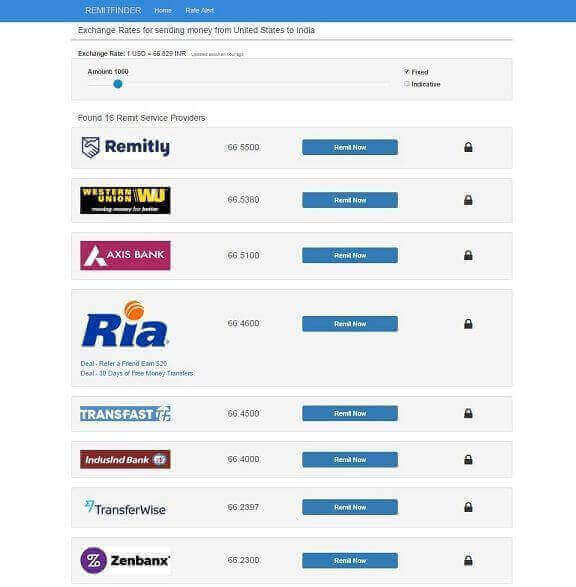
RemitFinder comparison tool for money transfers to India

Monito

Compares dozens of transfer services in real-time, showing the exact amount that will be received in India after all fees and exchange rate margins.

RemitFinder

Specializes in India remittances, comparing major providers and showing historical rate trends.

CompareRemit

Focused on Indian remittances with detailed provider reviews and promotional offers.

CurrencyShop

Provides side-by-side comparisons with detailed fee breakdowns and delivery time estimates.

Pro Tip:

Use these comparison tools even if you have a preferred service. Many providers offer promotional rates to new customers, so occasionally switching services can save you money.

8. Tax Implications and FEMA Regulations

Understanding the tax and regulatory framework is crucial for smooth, compliant transfers to India.

8.1. Tax Implications for the Receiver in India

Good News:

According to the Foreign Exchange Management Act (FEMA), taxes are not applicable if you send money to your children, spouse, parents, siblings, linear descendants or ascendants, and siblings of your spouse. These transfers are considered gifts and are tax-exempt.

However, there are important exceptions:

  • If the recipient is not a relative as defined above, amounts exceeding ₹50,000 in a financial year may be taxable as "Income from Other Sources"
  • Regular transfers for specific services rendered may be considered income and could be taxable
  • Investment-related transfers (for stocks, property) have their own tax implications based on the asset type

8.2. Tax Implications for the Sender

For those sending money from outside India:

  • Most countries don't impose tax on money sent abroad from already-taxed income
  • US residents may need to complete Form 3520 if sending gifts exceeding $100,000 annually (reporting requirement only, not taxation)
  • Some countries have currency control regulations limiting how much can be sent abroad

8.3. FEMA Regulations and Compliance

The Foreign Exchange Management Act (FEMA) governs foreign currency transactions in India:

  • There is no upper limit on the amount of money that can be sent to India
  • For transactions over certain thresholds, banks may request purpose codes and additional documentation
  • NRI transfers to NRE accounts are fully repatriable (can be converted back to foreign currency)
  • Transfers to NRO accounts have repatriation limits and may require tax clearance for reconversion

Important Note:

While inward remittances to India have favorable tax treatment, outward remittances from India are subject to TCS (Tax Collected at Source) at 5-20% depending on the amount and purpose.

9. Real User Experiences and Reviews

Learning from others' experiences can help you avoid pitfalls. Here are some insights from real users who regularly transfer money to India:

"Remitly is solid, no issues, have been using it for last 5ish years. Their express option gets the money in your Indian bank account in under 5 minutes."

- Reddit user from r/nri

"You can try Skydo. It just charges a flat fee and you don't have to pay forex markup. Your money will get converted with live exchange rates."

- Reddit user from r/nri

"I wanted to share my experience with Unplex for money transfers. It's the best service I've found, especially for transferring money to my India account."

- Review from CompareRemit

"I've been using Wise for over 2 years. Their rates are consistently better than banks by at least 2-3%. The app is straightforward, and transfers usually arrive within 1-2 business days."

- Personal experience shared online

9.1. Common Pitfalls to Avoid

Based on user experiences, here are common mistakes to avoid:

  • Not verifying recipient details thoroughly (account numbers, IFSC codes)
  • Assuming the service with the lowest transfer fee is cheapest overall
  • Failing to check if there are promotional rates for first-time users
  • Not considering the total delivery time, especially for time-sensitive transfers
  • Using credit cards to fund transfers (high fees and potential cash advance charges)
  • Transferring large amounts without comparing multiple services first

10. Conclusion and Action Plan

Minimizing currency conversion losses when transferring money to India requires awareness, comparison, and strategic timing. By implementing the strategies outlined in this guide, you could save 3-5% on each transfer—potentially thousands of dollars annually for regular or large transfers.

10.1. Your Money Transfer Checklist

Before Every Transfer:

  1. Check the current mid-market exchange rate on Google or XE.com
  2. Compare the total INR amount received across 2-3 services using comparison tools
  3. Consider transfer timing based on market conditions and urgency
  4. Verify recipient bank details and IFSC codes
  5. Choose bank transfer/ACH funding when possible to minimize fees
  6. Check for any promotional rates or first-time user bonuses
  7. For large transfers, explore forward contract options

10.2. For Regular Transfers

If you send money to India regularly, consider these additional strategies:

  • Set up rate alerts on multiple platforms and transfer when rates are favorable
  • Look into services offering loyalty programs or reduced fees for regular users
  • Consider sending larger amounts less frequently to minimize per-transaction fees
  • Explore NRE/NRO account options at Indian banks that offer preferential rates for account holders

10.3. Final Thoughts

The landscape of international money transfers is constantly evolving, with new services and technologies emerging regularly. By staying informed, comparing services routinely, and implementing the strategies in this guide, you can ensure more of your hard-earned money reaches its destination in India.

Remember:

The cheapest provider today might not be the cheapest tomorrow. Make comparison a habit, especially for larger transfers, and you'll consistently get the best value for your money.

Last Updated: May 24, 2025

Disclaimer: Exchange rates and service offerings mentioned in this article are subject to change. Always verify current rates and terms directly with the providers before making any financial decisions.

Thursday, 22 May 2025

How to Document Money Transfers to India for US Tax Compliance"

How to Document Money Transfers to India for US Tax Compliance: A Comprehensive Guide

How to Document Money Transfers to India for US Tax Compliance

A comprehensive guide for NRIs, expatriates, and US citizens transferring money to India

Updated: May 2024 Reading Time: 15 minutes
Money transfers from USA to India

Introduction: Understanding Tax Compliance for India-Bound Transfers

Sending money from the United States to India is common practice for many Non-Resident Indians (NRIs), expatriates, and US citizens with family or business ties to India. In 2023 alone, India received approximately $120 billion in remittances, with the USA being the second-largest contributor.

However, international money transfers come with significant tax and reporting obligations in both countries. Failing to properly document and report these transfers can result in severe penalties, including substantial fines and potential legal complications.

This comprehensive guide will help you understand the critical documentation requirements, reporting thresholds, tax implications, and compliance rules for transferring money from the US to India. By following these guidelines, you can ensure your transfers are fully compliant with both US and Indian regulations.

Table of Contents

  1. Key US Tax Forms for Documenting Money Transfers to India
  2. Reporting Thresholds and Requirements
  3. Documentation Best Practices
  4. Compliance Requirements in Both Countries
  5. Penalties for Non-Compliance
  6. The Proposed 5% Remittance Tax
  7. Frequently Asked Questions
  8. Expert Tips for Smooth Compliance

Key US Tax Forms for Documenting Money Transfers to India

FBAR (FinCEN Form 114)

The Report of Foreign Bank and Financial Accounts (FBAR) is required if you have financial accounts outside the US that exceed $10,000 in aggregate value at any point during the calendar year.

Due Date: April 15, with automatic extension to October 15

Filing Method: Electronically through FinCEN's BSA E-Filing System (not with your tax return)

Form 8938 (FATCA)

Statement of Specified Foreign Financial Assets, required under the Foreign Account Tax Compliance Act if you have specified foreign financial assets exceeding certain thresholds.

Due Date: Filed with your annual income tax return

Filing Method: Attached to your Form 1040

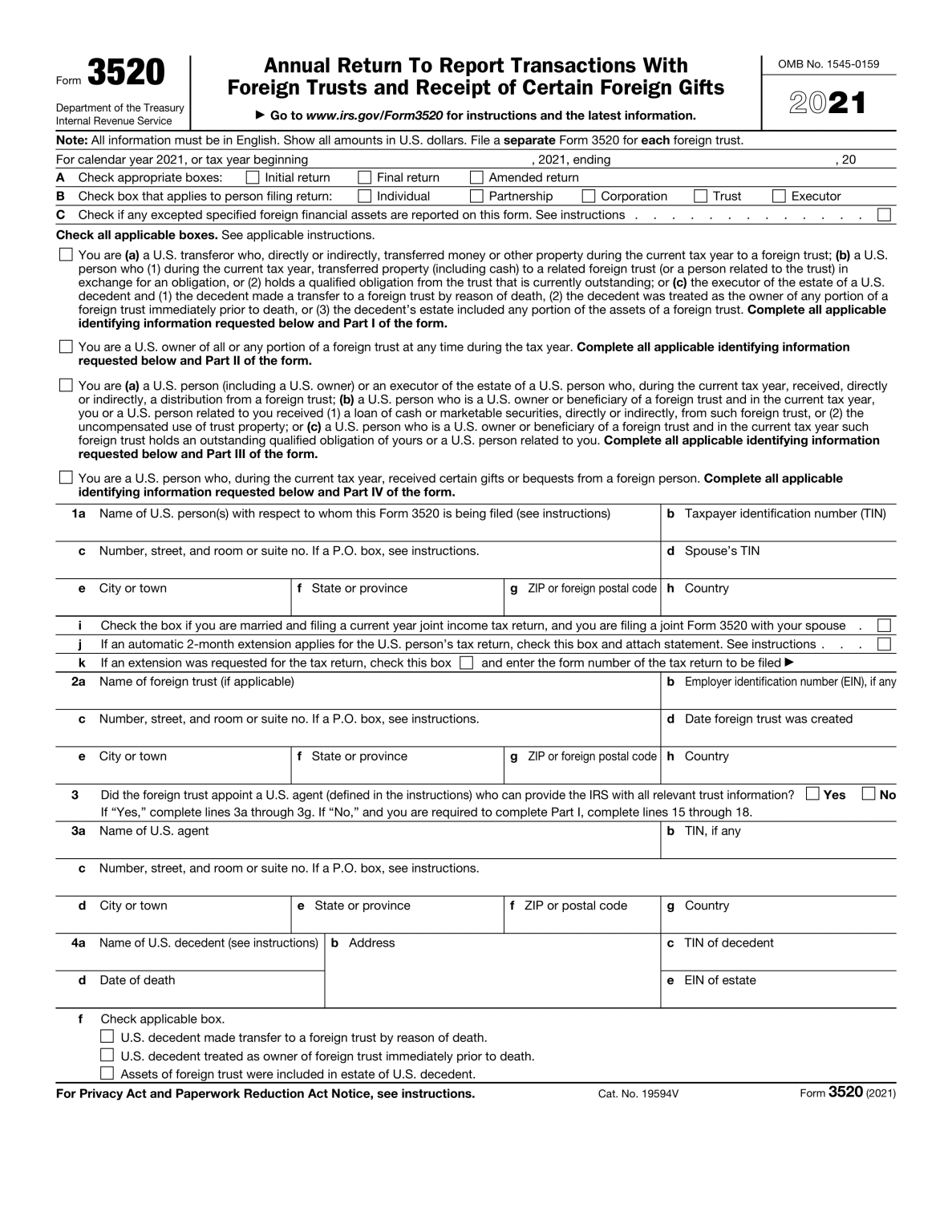
Form 3520

Annual Return to Report Transactions with Foreign Trusts and Receipt of Certain Foreign Gifts. Required if you transfer money to foreign trusts or receive large gifts from foreign individuals.

Due Date: 15th day of the 4th month following the end of your tax year (can be extended)

Filing Method: Filed separately from your tax return

Gift Tax Return (Form 709)

Required when you give gifts exceeding the annual exclusion amount ($18,000 for 2024) to an individual, including money transfers to individuals in India.

Due Date: April 15 of the year following the gift transfer

Filing Method: Filed separately from your income tax return

Important Note

Many international money transfers require reporting on multiple forms. For example, large transfers to relatives in India might need to be reported on both Form 709 (for US gift tax purposes) and Form 3520 (if they exceed certain thresholds).

IRS Form 3520

IRS Form 3520 - Required for reporting large gifts to foreign persons

Reporting Thresholds and Requirements

FBAR Reporting Thresholds

The FBAR filing requirement is triggered when your aggregate foreign financial accounts exceed $10,000 at any point during the calendar year. This is a cumulative threshold—if you have multiple accounts that together exceed $10,000, all accounts must be reported even if individually they are below this amount.

What Triggers FBAR Requirements for India Transfers?

  • Having signature authority over accounts in Indian banks
  • Maintaining NRE, NRO, or FCNR accounts in India
  • Being named on a family member's account in India
  • Holding investments through Indian financial institutions

Important: The $10,000 threshold applies to the combined value of all foreign accounts, not just those in India.

Form 8938 (FATCA) Reporting Thresholds

Filing Status Living in US Living Abroad
Single or Married Filing Separately $50,000 on last day of year or $75,000 at any time during the year $200,000 on last day of year or $300,000 at any time during the year
Married Filing Jointly $100,000 on last day of year or $150,000 at any time during the year $400,000 on last day of year or $600,000 at any time during the year

Form 3520 Reporting Thresholds

Form 3520 is required in several scenarios related to money transfers to India:

  • If you transfer property to a foreign trust
  • If you receive more than $100,000 as gifts from a foreign person (including family members in India) during the tax year
  • If you receive more than the threshold amount (varies annually) from foreign corporations or partnerships

Gift Tax Reporting Thresholds

For 2024, gifts exceeding $18,000 to any individual in a calendar year (including money transfers to relatives in India) may require filing Form 709, even if no tax is due because of the lifetime gift tax exemption.

Documentation Best Practices

Essential Records to Maintain

  1. Transaction confirmations from your bank or money transfer service
  2. Purpose of each transfer (family support, gift, investment, etc.)
  3. Receipts showing the exchange rates applied
  4. Bank statements showing the transfers
  5. Communication with recipients about the transfers
  6. Foreign bank account statements (if applicable)
  7. Any agreements related to the transfers

Documentation Timeline

Keep thorough documentation for at least:

  • 3 years - Standard IRS statute of limitations
  • 6 years - If you underreport income by more than 25%
  • Indefinitely - For transfers to foreign trusts or entities
  • 5 years - For FBAR-related documentation

Note: The statute of limitations may be extended for foreign financial assets not properly reported.

Pro Tip: Create a Transfer Documentation System

Establish a systematic approach to documenting all international money transfers:

  1. Create a dedicated folder (physical or digital) for each calendar year
  2. For each transfer, complete a cover sheet noting the date, amount, purpose, recipient details, and which US tax forms will be required
  3. Attach all supporting documentation
  4. Maintain a master spreadsheet tracking all transfers and reporting requirements
  5. Review with a tax professional annually

Required Information for FBAR Reporting

For each foreign account, you must keep records with:

  • Name on the account
  • Account number
  • Name and address of the foreign bank
  • Type of account
  • Maximum value during the year

Generally, these records must be kept for five years from the FBAR due date.

Compliance Requirements in Both Countries

US Compliance Requirements

IRS Requirements

  • Report foreign accounts on FBAR if aggregate balance exceeds $10,000
  • Disclose specified foreign financial assets on Form 8938
  • Report large gifts to foreign individuals
  • Document transfers to foreign trusts
  • Report foreign income on US tax returns

Bank Secrecy Act Requirements

  • Banks must report transactions over $10,000
  • Multiple smaller transfers may also be reported if they appear structured to avoid reporting

Indian Compliance Requirements

RBI Guidelines

  • Liberalised Remittance Scheme (LRS) allows resident individuals to receive up to $250,000 per financial year
  • Non-resident Indians have no specific inward remittance limits
  • Purpose of remittance must be documented
  • Recipient needs to report significant transfers from non-relatives

Indian Tax Implications

  • Gifts from relatives are tax-exempt in India
  • Gifts from non-relatives exceeding ₹50,000 in a year are taxable
  • Recipients may need to file appropriate tax declarations

Required Documentation from Both Sides

US Side Documentation

  • Identity verification (passport, driver's license)
  • Source of funds documentation
  • Purpose of transfer declaration
  • Recipient details
  • Relationship to recipient (for gift transfers)

Indian Side Documentation

  • Foreign Inward Remittance Certificate (FIRC) from beneficiary bank
  • KYC documentation for the recipient
  • Declaration of purpose for funds received
  • Documentation showing relationship to sender (for gift purposes)
Required Documents for Money Transfer

Documentation requirements for international money transfers

Penalties for Non-Compliance

Warning

The penalties for failing to properly document and report international money transfers can be severe and can accumulate quickly. Proactive compliance is always more cost-effective than addressing violations after the fact.

FBAR Non-Filing Penalties

Violation Type Penalty
Non-willful violation Up to $10,000 per violation (adjusted for inflation)
Willful violation Greater of $100,000 or 50% of account balance per violation (adjusted for inflation)
Criminal penalties Up to $250,000 and/or imprisonment up to 5 years

Form 8938 Non-Filing Penalties

  • Initial penalty of $10,000 for failure to disclose
  • Additional $10,000 for each 30 days of non-filing after IRS notification (maximum $50,000)
  • 40% penalty on understatement of tax attributable to non-disclosed assets
  • Extended statute of limitations for assessment

Form 3520 Non-Filing Penalties

  • Greater of $10,000 or 35% of the gross value of property transferred to a foreign trust
  • Greater of $10,000 or 35% of the gross value of distributions received from a foreign trust
  • 5% of gross value of trust assets owned by a US person if required information isn't provided
  • Additional penalties if non-compliance continues after IRS notification

Form 709 (Gift Tax) Non-Filing Penalties

  • Failure to file penalties (5% per month, up to 25% of tax due)
  • Accuracy-related penalties (20% of underpayment)
  • Fraud penalties (75% of underpayment due to fraud)
  • Interest on unpaid tax

Relief Options

The IRS offers various compliance programs for those who have failed to properly report foreign accounts or assets, including:

  • Streamlined Filing Compliance Procedures
  • Delinquent FBAR Submission Procedures
  • Delinquent International Information Return Submission Procedures

These programs may provide penalty relief for those who can demonstrate their non-compliance was not willful.

The Proposed 5% Remittance Tax

Remittance Tax Impact

What Is the Proposed Remittance Tax?

The "One Big Beautiful" Tax Act proposes a 5% tax on money transfers from the US to other countries, including India. This is a transaction-based tax that would apply each time money is sent abroad.

Implementation Timeline

If passed, the tax would be applicable from January 1, 2026, for all outbound transfers.

Who Would Be Affected?

The tax would primarily impact:

  • NRIs on H1B, L1, F1, OPT or similar visas
  • Green Card holders
  • Non-citizen U.S. residents

Who Would Be Exempt?

  • Verified U.S. citizens and nationals
  • Transfers via certified remittance providers registered with the IRS that can verify sender's citizenship

Collection Method

The tax would be collected at the source—by the money transfer service, bank, app, or remittance provider at the time of transfer.

Planning Strategies (If Implemented)

  1. Track all foreign transfers systematically
  2. Review your visa and citizenship status
  3. Choose compliant and transparent remittance providers
  4. Stay updated on legislative changes
  5. Consult with a cross-border tax advisor

Frequently Asked Questions

Do I need to report money I send to my parents in India?

Yes, if the amount exceeds the annual gift tax exclusion threshold ($18,000 per recipient in 2024), you should file Form 709 to report the gift, even if no tax is due. Additionally, if total transfers exceed $100,000, Form 3520 may be required.

Are money transfers to India taxable in the US?

Generally, sending money to India is not taxable as income for the sender. However, if the amounts exceed certain thresholds, you may need to report these transfers even if no tax is due. Large gifts may be subject to gift tax reporting requirements.

Do I need to file an FBAR if I don't have a bank account in India but just send money there?

Simply sending money to India doesn't trigger FBAR requirements. FBAR is required only if you have financial interest in or signature authority over foreign financial accounts with aggregate value exceeding $10,000 at any time during the calendar year.

Is there a limit to how much money I can send to India?

The US doesn't impose specific limits on how much you can send abroad, but transfers over $10,000 must be reported by financial institutions to the government. In India, there's no specific limit for non-residents sending money to India, but documentation requirements increase with larger amounts.

How do I document the purpose of my money transfer to India?

Keep records of the transfer's purpose (e.g., family support, gift, property purchase), correspondence with recipients, and any related contracts or agreements. If using a money transfer service, they often have a field to declare the purpose which should match your documentation.

Are student transfers to parents in India subject to special rules?

Students on F1 visas sending money to parents in India follow the same reporting rules as others. For amounts like $3,000-$4,000, there are typically no significant legal hurdles, but ensure the transfer complies with Anti-Money Laundering (AML) laws by using reputable transfer services.

Will the 5% remittance tax affect all money transfers to India?

If implemented as proposed, the tax would apply to remittances sent by non-U.S. citizens. U.S. citizens would be exempt. The tax would be collected at the time of transfer by the financial service provider.

How long should I keep documentation of my transfers to India?

Keep records for at least 3 years (the standard IRS statute of limitations), but 6 years is safer. For foreign accounts reported on FBAR, keep records for 5 years from the filing date. For large transfers or complex situations, consider keeping records indefinitely.

What happens if I didn't report my transfers to India in previous years?

The IRS offers various compliance programs for those who failed to properly report. Depending on your situation, you might qualify for Streamlined Filing Compliance Procedures or other programs that provide penalty relief if non-compliance was non-willful.

Do I need to report money transfers to India on my US tax return?

Generally, money transfers themselves aren't reported directly on your Form 1040. However, depending on the amount and nature of the transfers, separate forms like Form 709 (Gift Tax Return), Form 8938 (FATCA), or Form 3520 may need to be filed alongside your tax return.

Expert Tips for Smooth Compliance

Use Consistent Transfer Methods

Select 1-2 reputable money transfer services for all your remittances to India. This creates a consistent paper trail and simplifies documentation. Banks and established money transfer services typically provide detailed transaction records that can be useful for tax documentation.

Time Your Transfers Strategically

Consider the tax implications of the timing of your transfers. Large transfers near year-end may trigger reporting requirements for that tax year. If you're planning substantial transfers, consider splitting them across tax years if that helps with compliance or tax planning.

Create a Tax Calendar

Develop an annual tax calendar that includes all filing deadlines related to international transfers and accounts. Include FBAR filing (April 15), Form 8938 (with tax return), Form 3520 deadlines, and any Indian reporting requirements.

Work with Specialized Tax Professionals

Engage tax professionals who specialize in cross-border taxation and US-India financial matters. They can provide tailored advice for your specific situation and help ensure complete compliance with all applicable regulations.

Advanced Compliance Strategy

Consider creating a comprehensive "International Transfer Compliance Folder" with:

  • A master tracking spreadsheet of all transfers
  • Documentation templates for consistent record-keeping
  • A file organization system for physical and digital records
  • Checklists for annual reporting requirements
  • Contact information for financial institutions, tax professionals, and relevant government offices

This approach can significantly reduce the stress associated with tax compliance and minimize the risk of penalties.

Expert Reviews

5.0

"The most comprehensive guide I've seen on documenting US-India money transfers. Tax compliance in this area is complex and often overlooked, but this resource covers all the essential aspects that NRIs need to understand."

- Raj Sharma, CPA

US-India Tax Specialist

4.5

"As someone who specializes in FBAR compliance, this guide provides exceptional detail on the reporting requirements that many NRIs miss. The section on documentation practices is particularly valuable."

- Sarah Johnson

International Tax Attorney

Conclusion

Properly documenting money transfers from the US to India is essential for maintaining compliance with tax regulations in both countries. By understanding the reporting thresholds, keeping thorough documentation, and staying informed about changing requirements (like the proposed remittance tax), you can avoid costly penalties and ensure smooth financial transactions.

Remember that different forms have different filing requirements and deadlines. The FBAR must be filed electronically by April 15 (with automatic extension to October 15) if your foreign accounts exceed $10,000 at any time during the year. Form 8938 is filed with your tax return if your foreign financial assets exceed the applicable threshold. Form 3520 may be required for large gifts or transfers to foreign trusts.

While the documentation requirements may seem overwhelming, establishing a systematic approach to record-keeping from the beginning will make the process much more manageable. Consider working with tax professionals who specialize in US-India taxation to ensure full compliance and optimize your financial strategies.

As regulations continue to evolve, including the potential implementation of the 5% remittance tax, staying informed and maintaining comprehensive records will be your best protection against compliance issues.

Key Takeaways

  • FBAR filing is required if foreign accounts exceed $10,000
  • Form 8938 thresholds vary based on filing status and residence
  • Gifts over $18,000 to individuals require Form 709
  • Form 3520 is needed for large gifts from foreign persons
  • Maintain thorough documentation for at least 3-6 years
  • Penalties for non-compliance can be substantial
  • A proposed 5% remittance tax may affect transfers starting 2026

Stay Compliant Checklist

  • Track all international transfers systematically
  • Document purpose and relationship for each transfer
  • Keep records of transaction confirmations
  • Report foreign accounts if over $10,000
  • File gift tax returns for large transfers
  • Consider timing of transfers for tax planning
  • Consult a cross-border tax specialist annually

Important Deadlines

  • FBAR Filing April 15
  • FBAR Extension October 15
  • Form 8938 Tax Return Due Date
  • Form 3520 15th day of 4th month
  • Gift Tax Return April 15

Common Pitfalls to Avoid

  • Ignoring FBAR requirements for small accounts
  • Assuming gifts to family don't need reporting
  • Failing to document transfer purposes
  • Using multiple small transfers to avoid reporting
  • Forgetting about foreign investment accounts
  • Missing extended deadlines for filing

Tax Compliance Resources

This comprehensive guide was created to help NRIs and US citizens understand their tax obligations when transferring money to India. While we strive for accuracy, tax laws change frequently.

Always consult with a qualified tax professional for advice specific to your situation.

Tags

FBAR Form 8938 Form 3520 Money Transfers India NRI Tax Compliance Remittance Foreign Accounts

© 2024 - This article is for informational purposes only and does not constitute tax, legal, or financial advice.